
Lake & Pond Dredging Services & Sediment Investigation
What is Sediment Build Up & Why Do I Need A Sediment Investigation?
All lakes and ponds have a natural life span and fill up with sediment over time. Sediment accumulation can be accelerated by shoreline erosion, runoff, or the seasonal buildup of organic material like submerged aquatic plants and leaves from trees. Eventually, every lake and pond require the sediment to be removed and needs to be dredged in order to maintain their intended use, whether its recreation or stormwater storage.
At ILM Environments, we don’t just “dig out” lakes and ponds. Since 1987, we have provided science-based pond dredging services and sediment investigation that prioritize long-term stability, regulatory compliance, and cost-efficiency. Based in Waukegan, IL, our team manages the entire lifecycle of a dredging project from the initial sediment mapping, permitting, dredging, to the final sediment disposal.
What Is Sediment Investigation & Why It Comes Before Dredging?
A sediment investigation tells us how much sediment buildup there is in your lake or pond. It includes a bathymetric survey, which is an underwater topographical survey of the bottom of water body. It involves measuring the depth of water and the amount of sediment present before we reach the original, hard bottom. We collect data points throughout the waterbody using either sonar or sediment probing poles, or both, depending on conditions, and GPS track data collection points for future reference. We use ESRI ArcMap software to create bathymetric, sediment thickness, and total depth maps and to calculate sediment volumes in order to make recommendations on how much lake sediment removal is necessary.
Lake & Pond Dredging Service
When a sediment investigation reveals that your lake or pond has an unhealthy accumulation of sediment, we typically recommend dredging. Dredging is the partial or complete removal of sediment layers rich in nutrients and organic matter. Often the goal is to return the lake or pond back to its original depth while reducing nutrients, like phosphorus, that feed algae and aquatic plants that can grow out of control. After decades of sediment accumulation, dredging is often the best option to restore a degraded lake or pond back to its beauty and function.
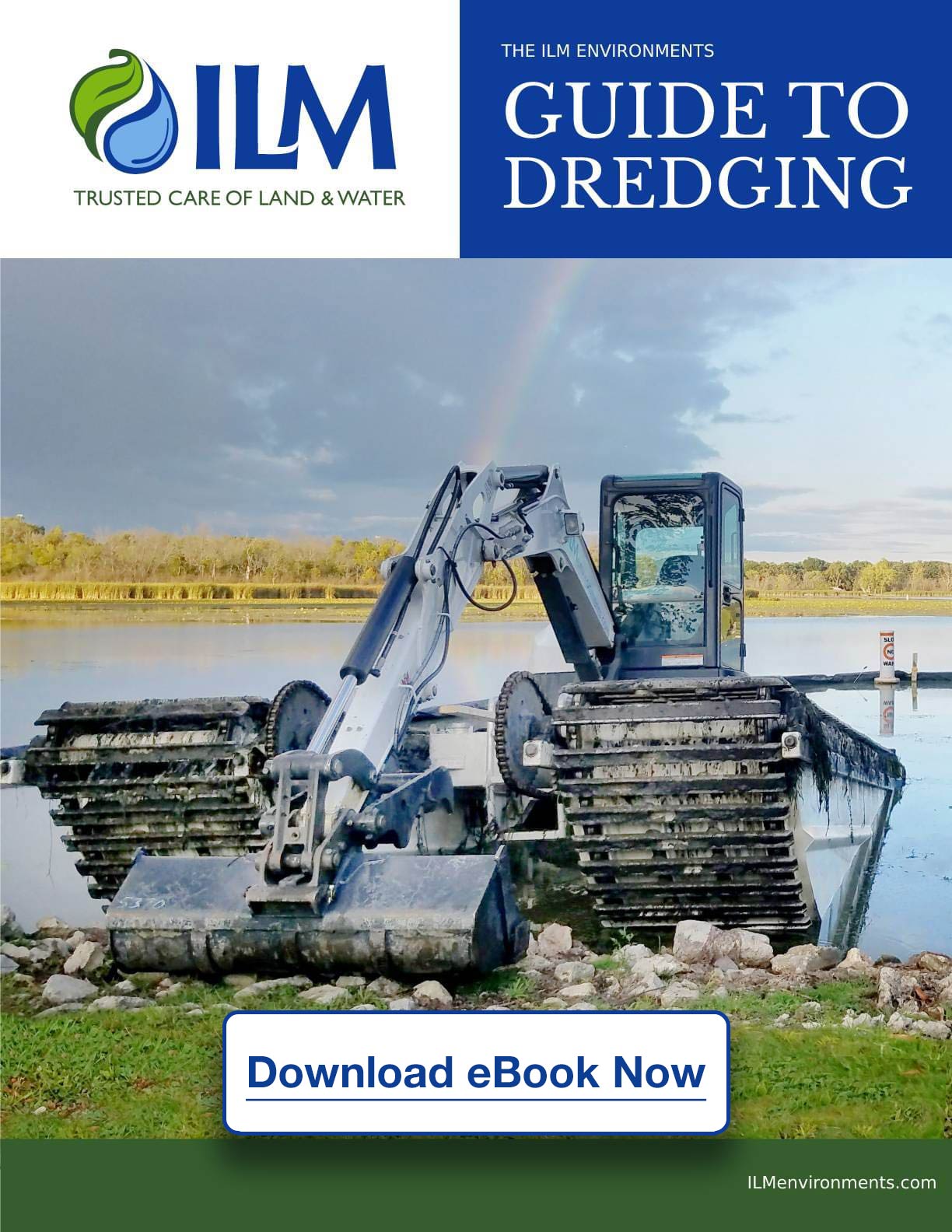
ILM Environment’s Guide to Dredging
Dredging is an important part of keeping a lake, pond, or other body of water clean and healthy.
Hydraulic & Mechanical Dredging Solutions
Hydraulic Dredging
Hydraulic Dredging uses suction and is especially effective when removing loose muck. Hydraulic dredges work like a vacuum, sucking up a mixture of sediment and water and transferring it through a hose into, most often, a dewatering bag. The sediment stays in the bag and cleans water returns to the waterbody. During hydraulic dredging, polymers are often used as a coagulating agent to bond suspended particles together and aid in the dewatering process. When the fine particles bond together it increases their overall mass, also called a floc, and they drop out of the water column much quicker.
Hydraulic dredging is limited by the onshore space to keep the dewatering bag(s). Hydraulic dredging is especially cost-effective when there is a use for the dredge material on site. Our Truxor mini-hydraulic dredge is great for dredging ponds and small lakes or performing maintenance dredging, especially around docks, on larger bodies of water.
Mechanical Dredging
Mechanical dredges work by mechanically digging sediment from the bottom using an excavator with a bucket. Mechanical dredging can be done either in the dry or “in the wet”. Dry mechanical dredging involves either partially or completely draining the pond or lake and using a long-reach excavator to scoop material from the bottom and into trucks. The material is either repurposed on-site or transported to the nearest disposal site.
We also have a specialized amphibious excavator which allows us to work farther away from shore or in difficult conditions where a traditional excavator would sink. In this case, the material is scooped into a barge or sled and then transferred into trucks and hauled away. Wet mechanical dredging does not involve drawing down the pond or lake and therefore can cause sediment resuspension. Wet mechanical dredging is done from shore or from a floating amphibious excavator.
Dredging Permits & IEPA Compliance
Contact Us Today to Schedule a Sediment Investigation
Interested in learning more about our pond and lake sediment removal, investigation, and dredging services? Or perhaps you are looking for other holistic strategies to care for your environment? Contact us today! We are happy to help you improve the beauty and health of your lake, pond, wetland, woodland, or prairie.